

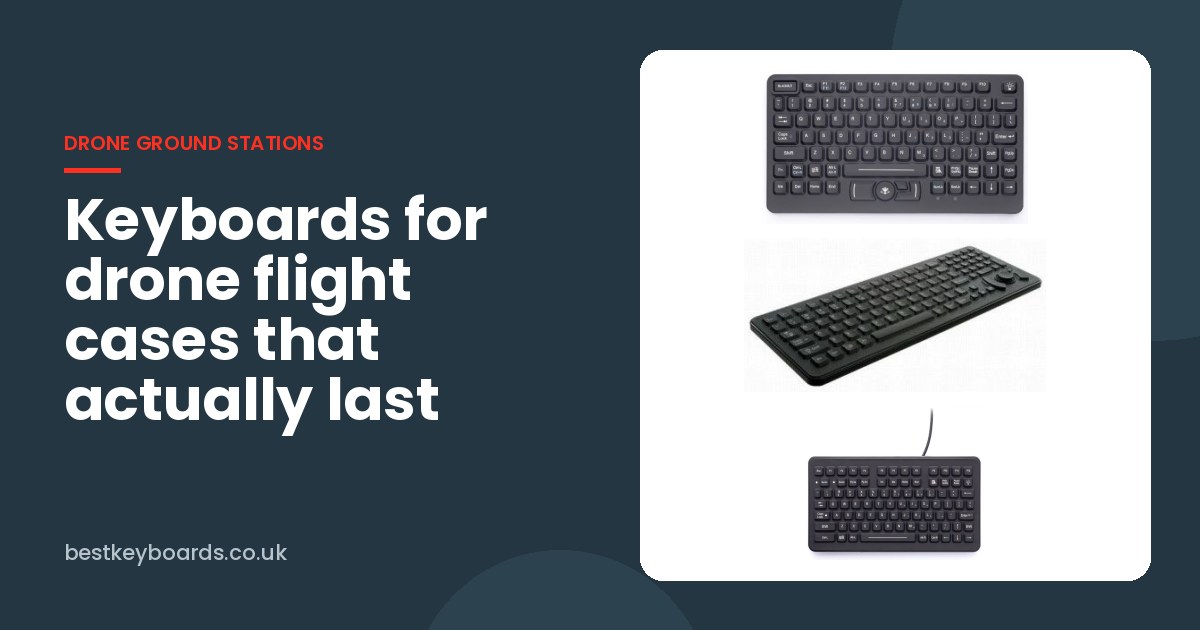
If you build ground control stations for drones, you will already know the routine. A Nanuk or Peli case, a rugged laptop or small-form-factor PC, a sunlight-readable screen in the lid, and a keyboard set into the lower half. Everything gets cut into foam or mounted on a custom panel, the case gets thrown in the back of a van, and then it spends its working life being opened on wet airfields, dusty quarries and cold hillsides at six in the morning.
Most of the parts in that case can be swapped out without much drama. The keyboard is different. It is the one component the operator is touching constantly, with cold hands, sometimes with gloves on, and often with rain running off the lid onto it. Pick the wrong one and it is the first thing to fail.
We have supplied keyboards to drone companies and flight case builders for years, and over that time the list of models that keep coming back has got very short. These are the ones that survive.
It is worth being honest about the conditions, because a lot of keyboards sold as "rugged" were really designed for a factory floor or a hospital ward, not the back of a 4x4.
That last point is why compact, sealed silicone keyboards with a built-in pointer, or a compact board paired with a separate panel-mount trackball, dominate this kind of build.
If we had to pick one keyboard that turns up in more drone cases than any other, it would be the iKey SL-86-911-OEM. The SL-86-911 started life as an in-vehicle keyboard for police and emergency services, which is exactly why it works so well in a case. It was designed to be bolted into a console, banged about and used in poor light.
The OEM version is the one integrators want. It comes without the full desktop housing, so it can be fitted directly into a panel or case insert and sit flush with everything else.
According to iKey's SL-86-911-OEM data sheet:
There is also an SL-86-911-OEM-FSR version, which swaps the HulaPoint for a force sensing resistor pointer. Some operators prefer the feel of the FSR, especially with gloves on, so it is worth trying both if you can.
Not every ground station is a small case. Survey, mapping and inspection work often involves a lot of data entry: flight plans, coordinates, notes, file names. For those builds a compact board can feel cramped, and that is where the iKey SLK-102-FSR comes in.
It is a full-size layout with a proper numeric pad, but it is still slim enough to sit in a larger case. From the iKey SLK-102-FSR data sheet:
The numeric pad is the real reason people choose it. If your operators are typing coordinates all day, they will thank you for it.
The third combination we see again and again is the iKey SL-88 paired with a separate Cursor Controls trackball, usually the X38 or the X50.
The SL-88 is a small, sealed, backlit keyboard with no built-in pointer. That sounds like a drawback, but for a lot of drone operators it is the point. A dedicated trackball gives much finer cursor control than a small pointing stick or touchpad, which matters when you are placing waypoints on a map or adjusting a camera gimbal on screen. Builders put the keyboard and trackball side by side in the case and get the best of both.
The SL-88-OEM version, which is the one most integrators fit, is listed by iKey at:
On the trackball side, both Cursor Controls models are optical panel-mount units designed to be fitted from behind a panel:
If you are flying at night with night vision equipment, look at the SL-88-NV, which has NVIS Green B backlighting to avoid bloom in goggles.
A lot of the builds we supply end up in Nanuk cases. Nanuk's drone series brochure lists the cases as IP67 rated, with an NK-7 resin shell, PowerClaw latches and an automatic pressure release valve. That is a good home for electronics, but bear in mind the case is only sealed when it is shut. As soon as the lid is open in the field, the keyboard is on its own.
A few things we have learned from case builders over the years:
There are cheaper keyboards out there, and we have seen plenty of them tried in drone cases. They usually look fine on day one. The problem is what happens after a winter of field work: sticky keys, dead backlights, pointers that drift, and a customer who now has to strip down a case to replace a part.
The models above have been in production for years, the footprints have not changed, and they keep turning up in the same builds for a reason. If you are designing a new case, using a part that you know will still be available and still fit next year saves a lot of headaches.
If your build needs custom legends, OEM variants or help with integration, our supply and support partner Rugged Limited has been doing exactly that for UK defence, aerospace and systems integrators for 25 years.
Every case is a little different, and the right keyboard depends on what your operators are actually doing. If you are building ground control stations and want a second opinion on layout, pointing device or sealing, send us the details and we will put a quote together. We usually reply within 24 hours, and we are happy to talk through OEM options, NVIS backlighting and custom legends.
You can also browse our full range of keyboards for defence, aerospace and vehicles or everything we list from iKey.