

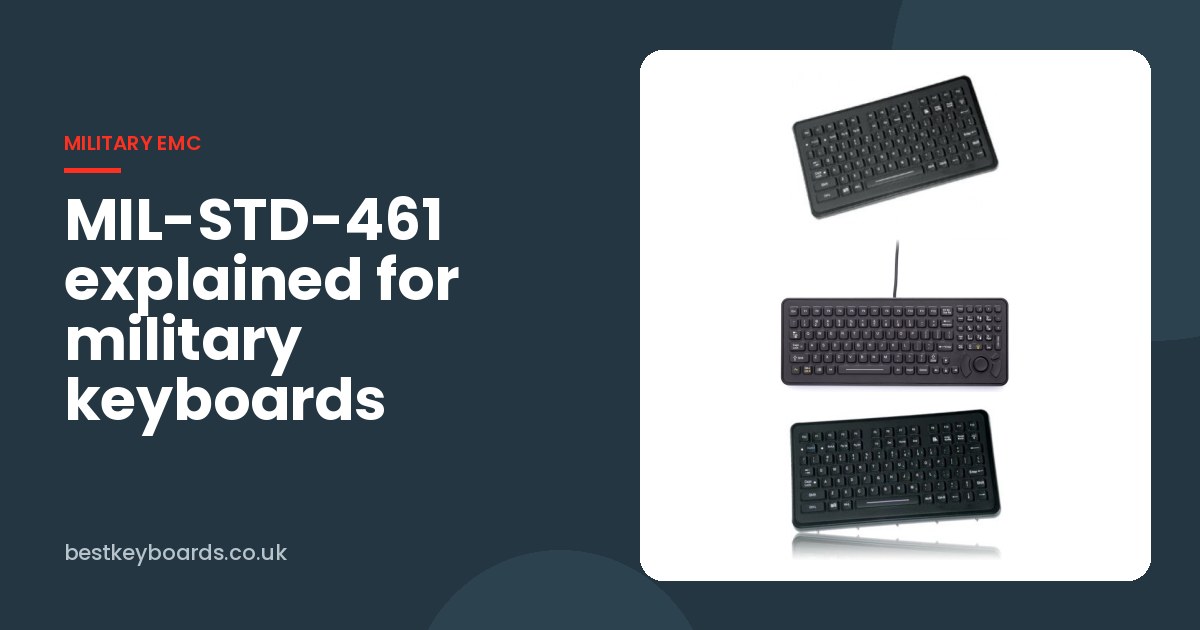
Most people asking for a "military keyboard" are thinking about toughness. Will it survive being dropped, rained on, frozen and shaken about in the back of a vehicle? Those are fair questions, but on a lot of defence programmes they are not the ones that cause problems. The keyboard that gets a project into trouble is usually the one that passes every drop test and then fails EMC.
That is where MIL-STD-461 comes in. If your keyboard is going anywhere near radios, radar, navigation equipment or a vehicle's electronic systems, it is very likely that somebody on the programme will ask whether it meets 461. This post explains what that actually means, why a keyboard can cause trouble at all, and which keyboards we supply for this kind of work.
MIL-STD-461 is the US Department of Defense standard for electromagnetic interference. In plain terms, it sets out requirements for the control of EMI emissions and susceptibility in electrical and electronic equipment. It is used well beyond the US, and it turns up in plenty of UK and European defence specifications too.
The tests fall into four families:
Within those families are individual test methods with names like CE102, RE102, CS114 and RS103. Not every method applies to every platform. The standard includes a requirements matrix that marks each test as applicable, limited or specified by procurement for surface ships, submarines, aircraft, space systems and ground equipment. The current revision, G, also removed CS106 and added CS117 and CS118, the last of which covers electrostatic discharge from personnel.
It seems odd at first. A keyboard is hardly a radio transmitter. But every USB keyboard contains a small microcontroller that scans the key matrix, a clock running it, a cable carrying data back to the computer, and often LED backlighting with its own drive circuitry. All of that switches on and off very quickly, and fast switching produces electrical noise.
On a desk in an office, nobody notices. In a vehicle with a radio set mounted a foot away, or on a ship's bridge surrounded by navigation equipment, that noise can show up as hiss on a radio channel or interference on a sensitive receiver. And it works the other way too. A keyboard sitting next to a powerful transmitter can be hit with enough energy to produce phantom key presses or lock up entirely. Neither is acceptable in a command post.
The cable matters as much as the keyboard. CS114, for example, simulates coupling from external electromagnetic fields onto cables by injecting RF current through a probe clamped around the cable. A metre of poorly screened cable makes a very effective aerial.
These two get mixed up all the time, sometimes even in tender documents, so it is worth being clear.
A keyboard can be extremely tough and still fail 461, and a keyboard can pass 461 and be completely unsuitable for a wet, cold vehicle. For most defence installations you need to think about both. When a customer tells us they need a "MIL-spec" keyboard, the first thing we ask is which standard, and which revision.
iKey has built a range of 461 versions of its rugged silicone keyboards. They share the sealed construction of the standard models, with the electronics and cabling designed to keep emissions down.
The SL-88-461 is the one we see most often in vehicles and small consoles. According to the iKey SL-88-461 data sheet:
There is also an SL-88-461-OEM for integrators who want to build the keyboard into their own enclosure.
For consoles and equipment racks where the keyboard needs to sit flush, the SLP-88-461 is the panel mount equivalent. Its data sheet lists:
This catches people out more than anything else. MIL-STD-461 has been through several revisions, and documentation for different products cites different ones. As you can see above, iKey's current SL-88-461 data sheet cites revision G, while the panel mount SLP-88-461 data sheet cites E.
Our advice is simple. Check your programme's specification for the exact revision and the specific test methods called up, then ask us for the supporting documentation for the model you are considering before you commit. It is much easier to sort out at quotation stage than after a system has failed qualification.
A keyboard designed to meet 461 can still cause problems if it is installed badly. A few things we would always look at:
For defence programmes that need documentation, configuration control or long-term supply, we work with our supply and support partner Rugged Limited, who have been supplying rugged keyboards to UK defence and aerospace customers for 25 years.
We have supplied rugged keyboards and pointing devices into defence and aerospace programmes for many years, and we are used to the paperwork that comes with them. If you need a keyboard that meets MIL-STD-461, send us your requirement, including the revision and the platform, and we will come back with options and a quote. We usually reply within 24 hours.
You can also browse our full range of keyboards for defence, aerospace and vehicles and our panel mount keyboards.