

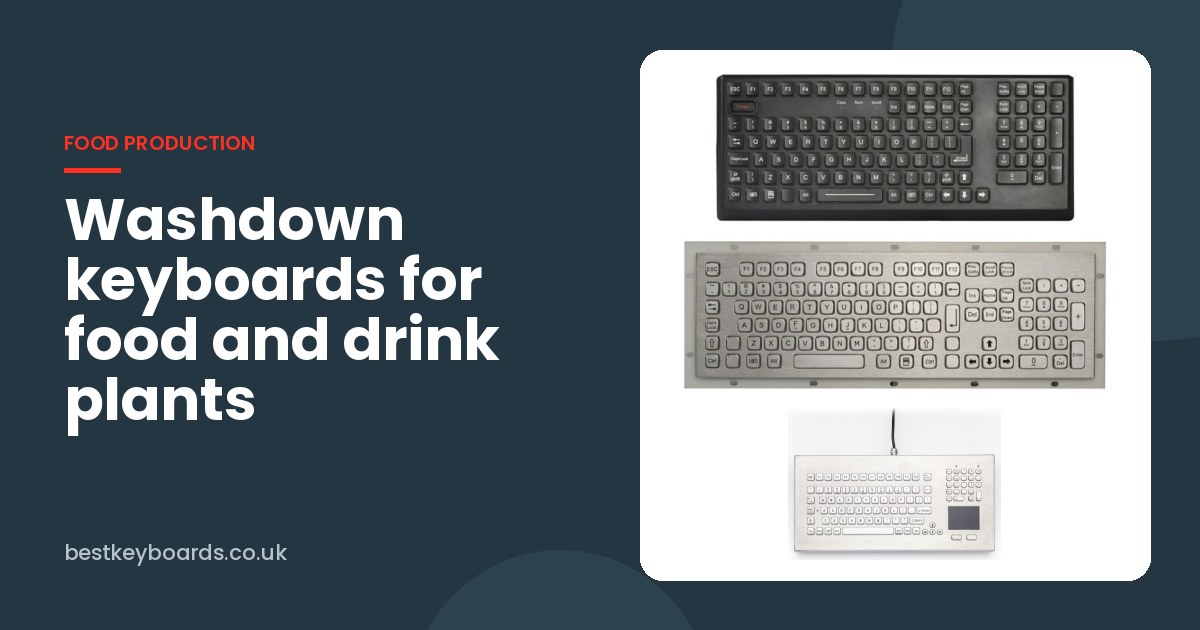
Walk round most food and drink factories after the end-of-shift clean and you will find at least one office keyboard wrapped in cling film. It is a sign that someone on site knows the keyboard should not be there, but nobody has found the time to replace it.
We understand why. A keyboard is a small item on a long list, and a standard one works fine on day one. The trouble starts a few weeks into the cleaning schedule, when the hose, the foam and the sanitiser have done their work and the keys start sticking, the legends wear off and liquid gets under the board. By then it is not just a broken keyboard. It is a hygiene risk sitting in the middle of a production area.
This guide covers what actually happens to keyboards in food plants, what the IP ratings mean in practice, and which types of washable keyboard we recommend for different parts of the site.
A food factory is hard on electronics for reasons that have little to do with rough handling:
The answer is not more cling film. It is a keyboard that is sealed, can be cleaned with the same products as everything else on the line, and has as few places for dirt to hide as possible.
Every washable keyboard comes with an IP rating, and it is worth knowing what you are actually buying. IP codes are defined in IEC 60529 and explained on the IEC's IP ratings page. The first digit covers dust, the second covers water. For keyboards in food production, the useful ones are:
You will also see IP69K mentioned a lot in food equipment. It is a separate, much tougher test for close-range high-pressure, high-temperature cleaning. According to the summary of the IP code test conditions, it uses water at 80°C and 80 to 100 bar, sprayed from 10 to 15 cm. None of the keyboards in this article claim IP69K, and we would be wary of any keyboard that does without a test certificate to back it up. In practice, most sites keep pressure washers away from operator stations and clean keyboards by spraying and wiping, which is exactly what IP67 and IP68 keyboards are made for.
One more detail: the RUGGED range describes many ratings as "dynamic". In that range, a dynamic rating applies while the keyboard is in use, which is what you want on a line where people type with wet gloves.
For most food production areas, we start with a sealed silicone keyboard. The keys are moulded into one continuous surface, so there is nothing for crumbs, dough or liquid to get under, and it is comfortable to type on for long shifts.
The hygienic models in the RUGGED range are designed with exactly this in mind:
A feature we like on these models is the CLEAN key. According to the product listings, it locks the keyboard so it can be wiped down without unplugging it and without typing rubbish into whatever is open on screen. It sounds minor, but it is the difference between staff cleaning the keyboard properly and staff avoiding it.
For a simpler, lower-cost option, the InduKey TKG-086-IP68-WHITE is a waterproof silicone keyboard that can be completely disinfected, and white makes it easy to see when it needs cleaning.
Stainless steel suits areas where keyboards get knocked, scraped or treated roughly, and where they are mounted permanently into equipment. The same hygienic design guidance recommends stainless steel enclosures for food environments, with self-draining surfaces and no ledges where fluids can pool.
The trade-off is typing comfort. Stainless keys have short travel, so they are better for entering batch codes and weights than for writing long reports. If staff will type a lot, silicone is kinder on the fingers.
A washable keyboard only helps if it gets washed. A few things we suggest to customers:
Where the keyboard sits matters as much as what it is made of. Panel mounting a keyboard into a stainless console removes the gap underneath a desktop keyboard where debris builds up. If you use desktop models, mount them on a stand or arm that lets water drain away rather than pool around the base, and keep cables tidy and off the floor. Angled mounts help too, as liquid runs off rather than sitting on the keys.
Every plant is different, and the right answer for a bakery is not always the right one for a meat processor or a brewery. If you tell us the area, the cleaning chemicals and how the keyboard is mounted, we can narrow it down quickly. Get in touch for a quote and we usually reply within 24 hours.
You can also browse our full range of washable and sealed keyboards and keyboards for industrial and manufacturing sites.