

keyboard icon white

In-Vehicle Keyboards for Police, Ambulance and Fire: Choosing an iKey SL-86-911

Why the iKey SL-86-911 is still the keyboard of choice for emergency service vehicles, and how to pick between the HulaPoint, FSR, touchpad, flat, MIL-STD-461 and panel mount versions.
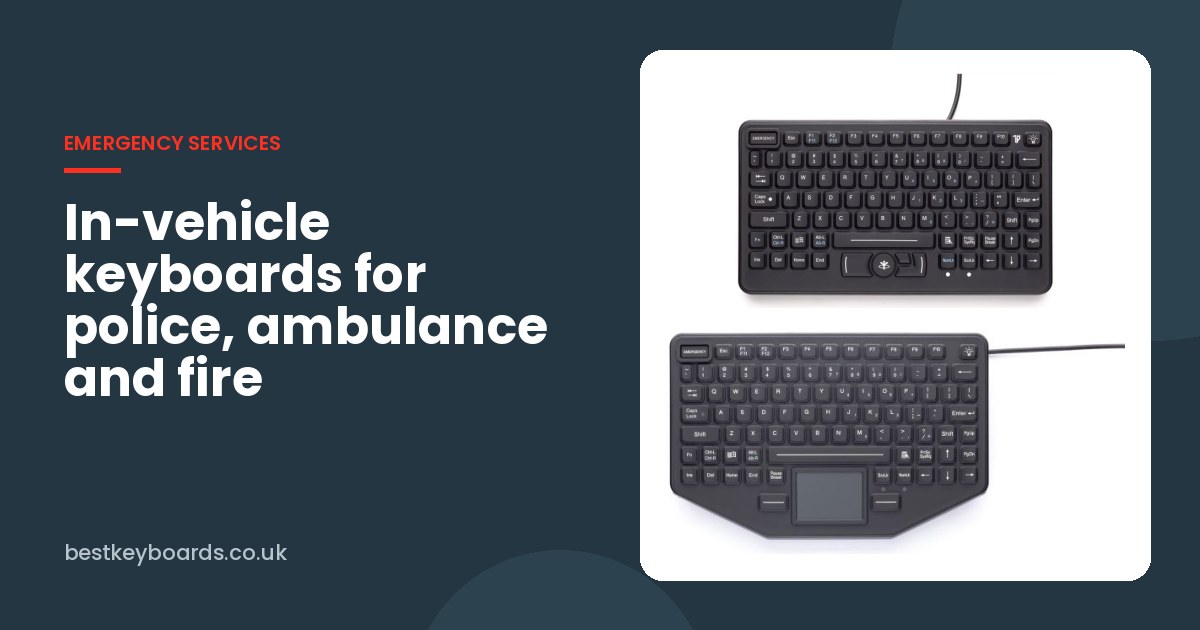
iKey SL-86-911 and SL-86-911-TP in-vehicle keyboards

Ask anyone who has fitted out a police car, an ambulance or a fire appliance and they will tell you the same thing. The vehicle computer is only as good as the bits the crew actually touch, and the keyboard takes more punishment than anything else in the cab.

It gets used on the move, in the dark, with gloves on, by people who are in a hurry. It gets coffee spilt on it, rain blown into it every time a door opens, and grit trodden in from every road verge in the county. And when it fails, the crew is left typing on a laptop balanced on their knee, or not logging the job at all.

The keyboard we have supplied for this kind of work more than any other is the iKey SL-86-911 family. Here is what makes it suitable, and how to choose between the different versions.

What an in-vehicle keyboard has to cope with

  • Constant vibration. Diesel engines, speed bumps, potholes and kerbs. Cheap keyboards develop dead keys and loose connections surprisingly quickly.
  • Night shifts. The cab is dark, and a bright screen and keyboard can ruin a driver's night vision. Backlighting needs to be there, but subtle.
  • Liquids and dirt. Drinks, rain, mud and, in an ambulance, body fluids and the disinfectant used to clean them up.
  • Temperature swings. A vehicle parked overnight in January and then left in the sun in July covers a wide range.
  • Limited space. The keyboard usually sits on a mount or tray between the seats, so it has to be compact and include its own pointing device.

The iKey SL-86-911

The SL-86-911 was designed specifically for public safety vehicles, and it shows. The "911" in the name refers to its dedicated emergency key, a one-touch button that can be mapped to an urgent function in the vehicle software.

The SL-86-911 data sheet lists:

  • 86 keys in a compact 290 x 160 mm housing, with mounting holes for vehicle consoles
  • Integrated HulaPoint II pointing device, so there is no mouse to lose under the seat
  • Red LED backlighting, which is easier on night vision than white or blue
  • NEMA 4X rated, with a completely sealed construction and 100% humidity resistance
  • Operating temperature of -20°C to +60°C
  • Shock tested at 50g on three axes and vibration tested from 20 Hz to 2 kHz
  • 4 ft coiled cable with USB or PS/2 connection

That combination of sealing, shock resistance and built-in pointer is why the SL-86-911 is also popular well beyond the emergency services, in plant machinery, delivery fleets, marine vessels and, as we covered in a separate post, drone flight cases.

Choosing the right SL-86-911 version

There are quite a few variants, and the differences matter once you are fitting them into a real vehicle.

Pointing device: HulaPoint, FSR or touchpad

  • The standard SL-86-911 uses a HulaPoint II, a small pointing stick that works well with gloves and on rough roads, because your finger is not sliding around.
  • The SL-86-911-FSR uses a force sensing resistor pointer, which some users find more precise.
  • The SL-86-911-TP has a touchpad, which is more familiar to anyone used to a laptop, but is harder to use accurately while the vehicle is moving.

Our honest advice: if the keyboard will mostly be used while parked up, crews tend to prefer the touchpad. If it will be used on the move, the HulaPoint or FSR versions are usually the better choice.

Flat or raised

The SL-86-911-TP-FL is a lower-profile version designed to drop into existing mounts. According to the iKey data sheet, it has a wider operating range of -40°C to +70°C and meets NEMA 4X (IP65). One thing to watch: it does not have mounting holes, so it relies on the mount or tray to hold it in place. If you need to bolt it down, the standard SL-86-911-TP is the one to go for.

Military and EMC sensitive vehicles

If the keyboard is going into a vehicle full of radios and sensitive electronics, look at the SL-86-911-461. It is designed to meet MIL-STD-461E, which covers electromagnetic emissions and susceptibility, so it can sit next to radio equipment without causing interference.

Panel mount and OEM

For vehicle builders who want the keyboard set flush into a dashboard or console, there are panel mount versions such as the SLP-86-911, and the SL-86-911-OEM for fully custom installations.

A few practical tips from fitting these

  • Mount it where the passenger can reach it. Very often the person using it is the passenger, not the driver, so angle the mount towards them.
  • Use the coiled cable. It stretches when the keyboard is lifted off the mount, and does not dangle into pedals or seat runners.
  • Agree the emergency key mapping early. It is easy to leave it unmapped, and then it is just a red button nobody uses.
  • Think about cleaning. In ambulances especially, the keyboard will be wiped down with strong disinfectant. A sealed silicone keyboard copes with that far better than a standard laptop-style board.

Why it keeps getting specified

Fleet managers do not want to think about keyboards. They want something that goes in at the start of a vehicle's life and is still working when the vehicle is decommissioned. The SL-86-911 has been around for years, the footprint has stayed the same, and replacements slot straight into existing mounts. For anyone looking after a large fleet, that consistency is worth a lot.

Many of the SL-86-911 keyboards we supply into emergency service fleets come through Rugged Limited, our supply and support partner, who have been supplying rugged keyboards for vehicles for 25 years. If you are planning a fleet-wide rollout, they are good people to have involved early.

Talk to us about your vehicles

If you are kitting out police, ambulance, fire, security or service vehicles, send us the details and we will put together a quote. Tell us about the mount, the computer and how the crews use it, and we will recommend the right version. We usually reply within 24 hours.

You can also browse our keyboards for defence, aerospace and vehicles or our keyboards with a built-in trackball or touchpad.

Thank you

Thank you for taking the time to read our post about In-Vehicle Keyboards for Police, Ambulance and Fire: Choosing an iKey SL-86-911. We truly appreciate your interest in our content! bestkeyboards.co.uk strives to be the ultimate destination for anyone seeking comprehensive information on computer keyboards. If you found this blog post, In-Vehicle Keyboards for Police, Ambulance and Fire: Choosing an iKey SL-86-911 enjoyable and informative, we would be grateful if you could leave a comment below and share it with your friends and colleagues. Your feedback and support mean a great deal to us and are what drive us to continue producing high-quality content for you. Please don't hesitate to reach out to us with any questions, comments, or suggestions for future blog topics. We truly value your input and love hearing from our readers.