

Every so often an enquiry comes in that starts with "we need a rugged keyboard for the plant" and, a couple of emails later, it turns out the keyboard is going into an area where there could be flammable gas or combustible dust in the air. That changes the conversation completely. At that point toughness and sealing are not the main question. The main question is whether the keyboard could ignite the atmosphere around it.
Hazardous area equipment is a specialist subject, and it is easy to get lost in the codes and acronyms. This guide covers the basics in plain English, explains what the markings mean, and is honest about what we do and do not have on the site.
One thing first: this is a starting point, not a substitute for your site's hazardous area classification or your safety engineer. If you are not sure which zone you are working in, that needs settling before anyone chooses a keyboard.
Any electrical device can, in the wrong conditions, create a spark or a hot surface. The HSE puts it simply: using electricity can generate hot surfaces or sparks which can ignite an explosive atmosphere. It gives examples such as paint spray booths, the area near fuel tanks and sumps.
A keyboard is a low-power device, but it still has a circuit board, a cable and a connection to a computer that is usually not low power at all. In a hazardous area, the HSE's guidance is that equipment must be specially designed and constructed so that the risk of ignition is eliminated or reduced.
In the UK, the Dangerous Substances and Explosive Atmospheres Regulations (DSEAR) require employers to assess the risk and classify areas where explosive atmospheres may occur. Those areas are divided into zones. The HSE's guidance on hazardous area classification defines them like this:
Each zone calls for a minimum equipment category. Zone 0 needs Category 1 equipment, Zone 1 needs Category 2 and Zone 2 needs Category 3. The Fire Industry Association's guide to equipment for explosive atmospheres sets out the same mapping for dust, so Zone 20 needs Category 1D, Zone 21 needs 2D and Zone 22 needs 3D.
On marking, the HSE says equipment placed on the market in Great Britain must be UKCA or CE marked, supplied with a Declaration of Conformity and have instructions in English, and that most new equipment sold in the UK for these areas must have an ATEX certificate. Recently installed equipment should also carry the Ex mark. You will often hear the UK version of the scheme called UKEX.
Two more parts of the marking matter when you are matching equipment to a site.
Gases are grouped by how easily they ignite. According to the FIA guide:
As the FIA guide puts it, group C requires the highest degree of protection and group A the lowest, so check the group on the equipment matches or exceeds the gas on your site. Dusts have their own groups (IIIA for combustible fibres, IIIB for non-conductive dusts and IIIC for conductive dusts).
The T rating tells you the maximum surface temperature the equipment can reach. The HSE lists six classes, from T1 at 450°C down to T6 at 85°C. The equipment's T class has to be below the ignition temperature of whatever substance is present on your site.
You will also see IECEx on data sheets. It is an international certification scheme, described by the IEC as an international certification initiative that ensures the safety and compliance of electrical and mechanical equipment. An IECEx certificate makes it much easier to get products approved in different countries, but it is not the same thing as the legal UK or EU marking. For a UK site, the thing to look for is still the UKCA or CE marking with the Ex mark.
This is the misunderstanding we come across most. A keyboard that is sealed to IP65 or IP68, or rated NEMA 4X, is protected against dust and water getting in. That is an ingress protection rating. It says nothing about whether the keyboard could ignite a flammable atmosphere.
Plenty of excellent industrial keyboards, including many on this site, are completely sealed and almost indestructible, and they are still not suitable for Zone 1 or Zone 2. The keyboard has to carry its own hazardous area certification for the zone, gas or dust group and temperature class it will be used in. If it does not say so on the label and the certificate, assume it is not.
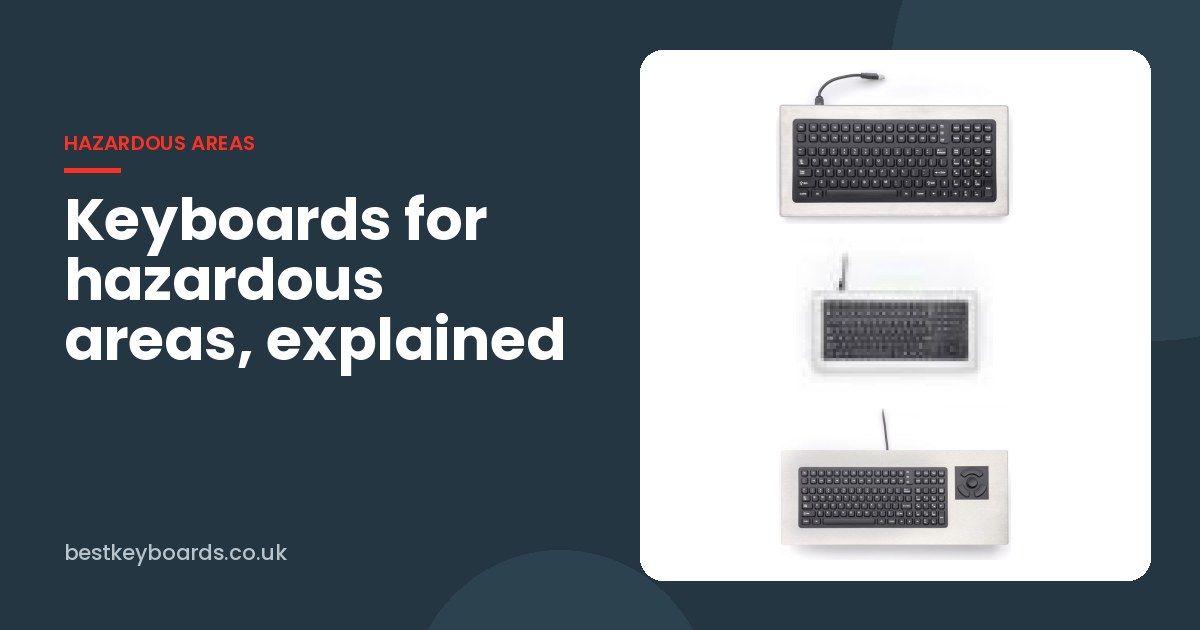
Intrinsically safe (IS) equipment works by limiting the electrical and thermal energy in the circuit so that it cannot ignite the atmosphere, even if something goes wrong. iKey makes a range of stainless steel IS keyboards that we list on the site:
These units come with optical isolated barriers and bulkhead cables. Here is the important bit, though. iKey's intrinsically safe range carries Factory Mutual (FM) approval for Class I, II and III, Division 1, Groups C, D, E, F and G. That is the North American Class and Division system, not ATEX or UKEX. iKey's product information does not list ATEX or IECEx certification for these models.
So if your site is in North America, or your project specifies FM approval, they may be exactly what you need. If your site is in the UK or EU and classified under DSEAR or ATEX zones, do not assume an FM approval covers you. Talk to your safety engineer, and talk to us, before ordering.
Hazardous area keyboards are not something to guess at. If you send us the zone, the gas or dust group and the temperature class, we will tell you honestly what we can supply and whether it fits. Send us your requirements and we usually reply within 24 hours.
If your keyboard will sit outside the classified area, have a look at our industrial and manufacturing keyboards and our stainless steel keyboards.