

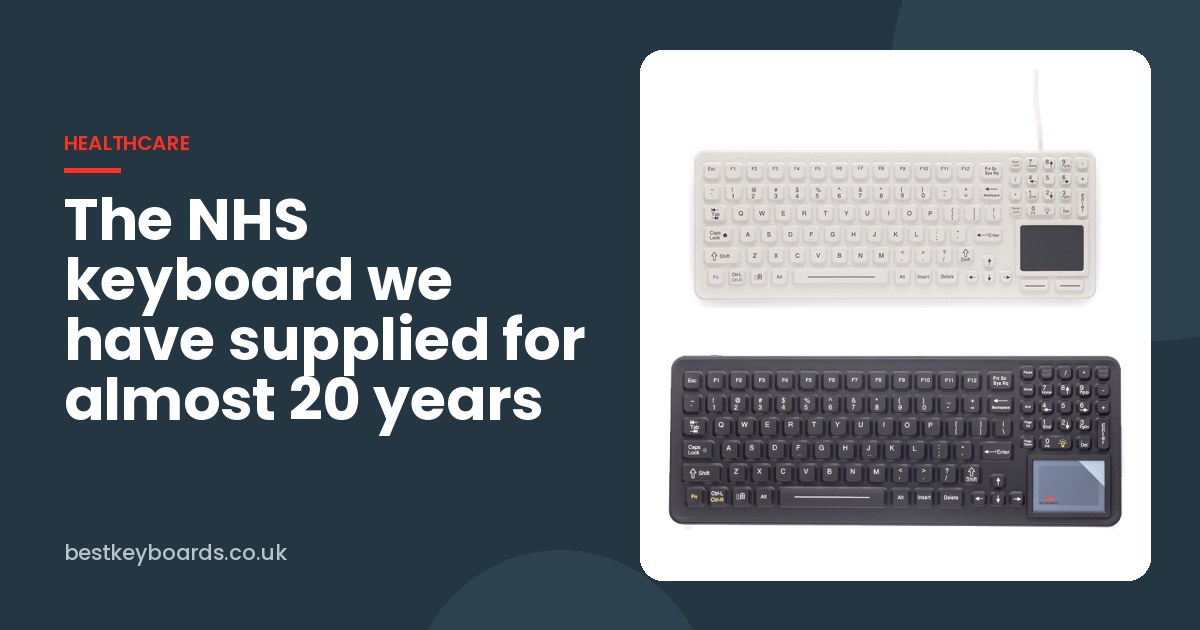
There are not many products in the IT world that stay the same for twenty years. Laptops come and go, monitors change every few years, and most keyboards are discontinued long before they wear out. So it says something that one of the keyboards we supply most often to the NHS today is essentially the same keyboard we were supplying in the mid 2000s.
That keyboard is the iKey SK-97-TP. Alongside its bigger, backlit sibling, the SLK-102-TP, it is now in use in hundreds of hospitals across the UK: in ICUs, on wards, on drug and computer trolleys, in theatres and in clinics. We have never found a good enough reason to replace it, and neither have the hospitals that use it.
This post is about why.
A standard office keyboard is full of gaps. Crumbs, dust, skin and moisture work their way under the keycaps and stay there, and you cannot properly clean it without taking it apart. In an office that is a bit grim. In a hospital it is an infection control problem.
This is not a new concern. In one well-known US study, 95 out of 100 keyboards sampled across clinical areas grew at least one microorganism, including staphylococcus, enterococci and a vancomycin-resistant strain. Keyboards on a ward get touched by dozens of people a day, often between patients, and they need to be cleaned as often as any other piece of shared equipment.
The trouble is that most keyboards do not survive being cleaned properly. Wipe them down with hospital-grade disinfectant several times a day and the legends wear off, the plastics craze, liquid gets inside and the keys start to fail. Staff quickly learn to stop cleaning them, which is the opposite of what you want.
The SK-97-TP was designed from the start to be cleaned, and that is really the whole story. It is a fully sealed silicone rubber keyboard with an integrated touchpad, so there is no separate mouse to clean and nothing for liquid to get into.
According to iKey's own specifications:
In practice, what matters to clinical staff is simpler than that list. You can spray it, wipe it, and keep using it. The keys have a proper tactile click, rather than the dead feel of some flat medical keyboards, so people actually like typing on it. And because the touchpad is built in, it fits neatly on a trolley or a bedside arm where there is no room for a mouse.
Over the years the SK-97-TP has ended up almost everywhere in the hospital:
A lot of our repeat orders come from hospitals simply buying more of the same. Once the IT and infection control teams have approved a keyboard and staff are used to it, there is very little appetite to change it, and that is fair enough.
The other keyboard we supply a lot of is the iKey SLK-102-TP. It does the same basic job, but adds red LED backlighting, which makes a real difference on night shifts and in darkened areas such as imaging rooms and ICU bays where the lights are kept low for patients.
From the SLK-102-TP data sheet:
If you want backlighting in the more compact SK-97-TP style, there is also the SLK-97-TP, and for areas where low-profile keys are preferred there is the SLK-102-TP-FL.
Hospitals do not buy keyboards the way an office does. A new keyboard has to work with the clinical systems, satisfy the infection prevention team, fit the trolleys and arms already in use, and survive whatever cleaning regime the trust follows. NHS England's National Infection Prevention and Control Manual sets out how shared care equipment should be decontaminated, and keyboards on a ward fall squarely into that category.
Every time a hospital changes a keyboard, someone has to go through all of that again. Sticking with a model that has nearly two decades of use behind it removes a lot of that risk. You know it cleans properly, you know it lasts, and you know you will be able to buy the same one again next year.
That long availability is underrated. A cheaper sealed keyboard can look like a saving, until it is discontinued a couple of years later and the trust ends up with a mixture of models across its wards. Standardising on one keyboard makes life much easier for IT, for estates and for the staff who use it.
Most of the SK-97-TP and SLK-102-TP keyboards we place in NHS trusts are supplied through Rugged Limited, our supply and support partner. They have been in rugged keyboards for 25 years and have looked after NHS customers for most of that time, so if your trust is standardising on one keyboard or planning a large order, they know the ground well.
For most wards and trolleys, the SK-97-TP is where we would start. If you need backlighting or a larger numeric pad, the SLK-102-TP is the natural step up. Both come in USB, and we can advise on colours, mounting options and quantities.
If you are looking after IT for a hospital, a clinic, a dental practice or a medical equipment manufacturer, get in touch for a quote. We usually reply within 24 hours, and we are happy to send details on cleaning compatibility for your infection control team.
You can also see the rest of our healthcare and medical keyboards and our full range of washable and sealed keyboards.