

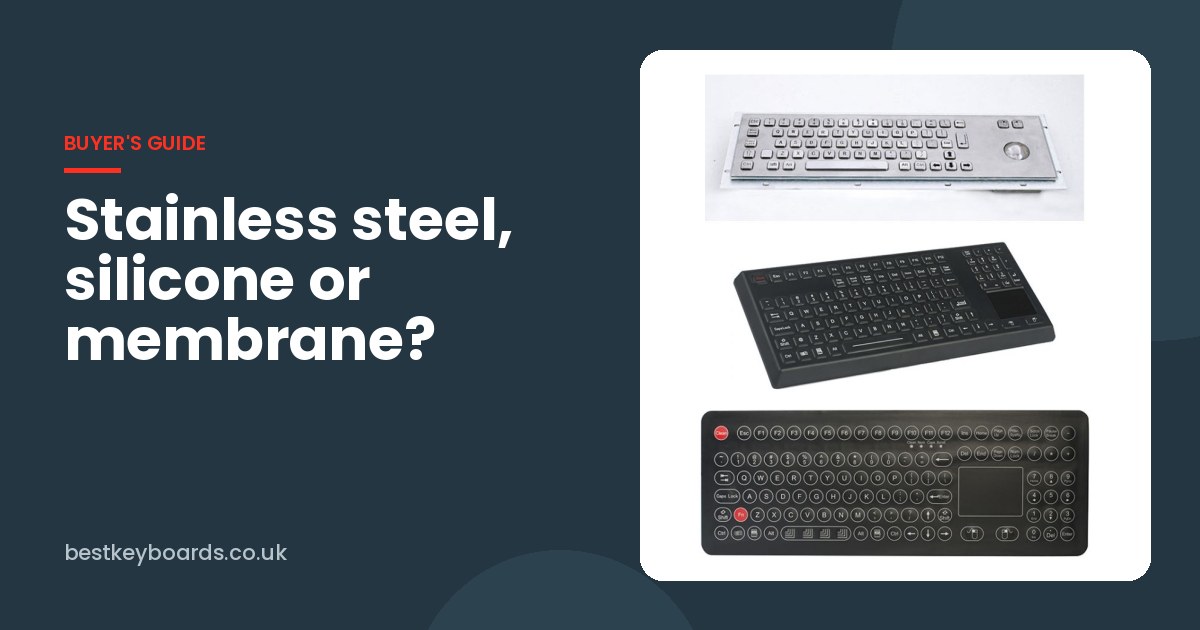
We get a lot of enquiries that start with "I need a rugged keyboard" and very little else. That is completely understandable, but "rugged" covers a huge range of products. A keyboard that is perfect for a food factory washdown area would be the wrong choice for a public kiosk, and a keyboard built for a ship's bridge would be overkill on a warehouse packing bench.
The RUGGED range is a good example. It includes stainless steel, silicone rubber and sealed membrane keyboards, in desktop, panel mount and OEM formats, with touchpads, trackballs and backlighting as options. This guide explains the main differences so you can narrow it down before you get in touch.
Before looking at models, it helps to answer four questions:
Those answers point you towards the right material and the right IP rating far more reliably than any spec sheet.
IP ratings come from the international standard IEC 60529, and the IEC's own guide explains them well. The first digit is protection against solids such as dust, and the second is protection against water. In practice, for keyboards:
You will also see the RUGGED range describe ratings as "static" or "dynamic". As the range uses it, a dynamic rating applies while the keyboard is being used, whereas a static rating applies to the keyboard at rest, typically from the front once it is panel mounted. If the keyboard will be cleaned or splashed while people are typing on it, a dynamic rating is the one to look for.
Stainless steel keyboards are the tough option. They are vandal resistant, they do not mind being hit, and they look at home in kiosks, ticket machines, help points, prisons, laboratories and factories.
A few examples from the range:
The trade-off is feel. Stainless keyboards use short-travel keys, so they are not as comfortable for long typing sessions as silicone or a standard office keyboard. For short bursts of data entry, they are ideal.
Silicone keyboards are moulded as a single sealed sheet, which means there are no gaps around the keys for dirt or liquid to get into. They are easy to clean, quiet, and much nicer to type on for long periods than metal.
This is the type we usually recommend for healthcare, food production, laboratories and anywhere that hygiene matters. It is also what many military and vehicle keyboards are based on, including the iKey models we cover in our posts on NHS keyboards and in-vehicle keyboards.
Membrane keyboards use a flat, sealed overlay over the key switches. They are very easy to wipe clean and can be made to high IP ratings while still giving you a full layout with a numeric pad. They are a popular choice for control rooms, industrial workstations and cleanrooms where you want a proper keyboard without the cost or weight of stainless steel.
Most of the range is available with either, and it is worth thinking about. Touchpads are flat and easy to clean, which suits hygienic areas. Trackballs give more precise control and work better with gloves, which is why they are common in industrial, marine and defence consoles. If the keyboard is in a public area, a stainless steel trackball is very hard to damage.
Quite often a customer needs something slightly different: a particular layout, extra function keys, a specific connector, a legend in another language, or a keyboard to fit an existing cut-out. Much of the RUGGED range is available in OEM and custom versions, and that is often the quickest route to getting exactly what you need.
The RUGGED range is supplied and supported through our partner Rugged Limited, a UK specialist that has been supplying and customising rugged keyboards for 25 years. Custom layouts and OEM versions are handled with them.
If you are not sure which way to go, tell us about your application and we will suggest a shortlist and a quote. We usually reply within 24 hours. You can also browse our stainless steel and metal keyboards, washable and sealed keyboards and panel mount keyboards.